


Please Leave Us A Message
Privacy statement: Your privacy is very important to Us. Our company promises not to disclose your personal information to any external company with out your explicit permission.


A 24-port fiber optic patch panel is the central termination point in structured cabling systems, designed to house splice trays and provide organized access for fiber jumpers. For network engineers managing high-density data centers or telecommunications hubs, this specific capacity represents the optimal balance between space efficiency and connectivity flexibility.
Unlike smaller configurations, a 24-port unit typically accommodates two LC duplex adapters or one SC/SC adapter per port row. This standard configuration allows IT managers to connect up to 48 individual fibers within a single rack unit (1U), significantly reducing the physical footprint required for network expansion while maintaining strict bend-radius control for signal integrity.
Shenzhen Guangtong Optical Co., Ltd, established in 2010, specializes in manufacturing these high-precision termination solutions. Our patch panels are engineered to support rapid deployment and simplify long-term maintenance for global enterprise networks.
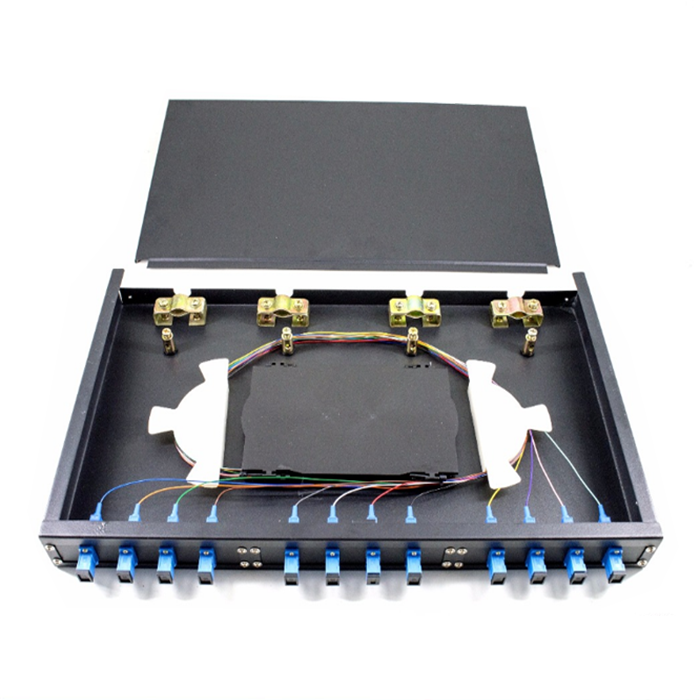
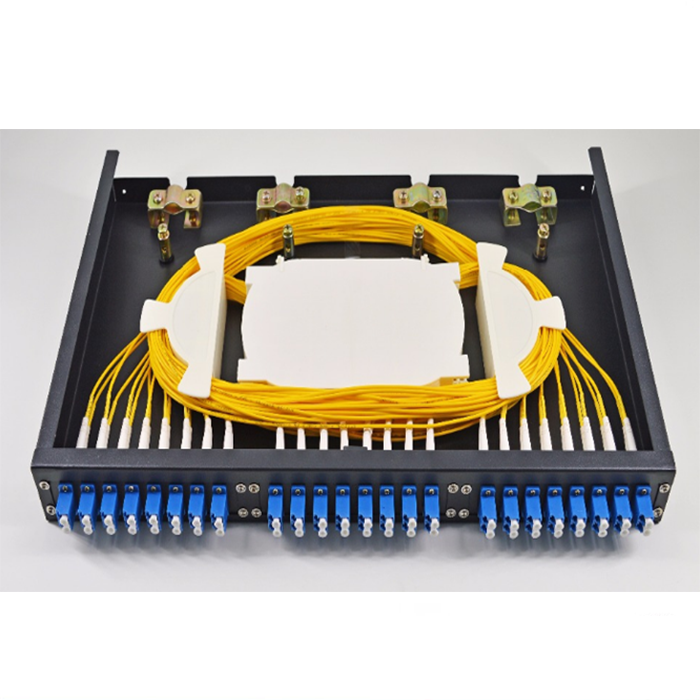
At Shenzhen Guangtong Optical, every 24-port fiber optic patch panel undergoes rigorous testing to ensure consistent low insertion loss and high return loss. Our facility utilizes advanced production equipment to manufacture SZ stranded cables, central tube cables, and ADSS cables, ensuring that the raw materials meet international standards.
Our quality management system is strictly controlled according to ISO 9000 guidelines. We prioritize material compliance with European Union directives and various international laws and regulations. This commitment ensures that our patch panels are environmentally safe and durable enough for harsh industrial environments.
We believe that attractive quality and standard management are the guarantees of industry improvement. By adhering to these principles, we deliver patch panels that reduce downtime and lower the total cost of ownership for procurement teams worldwide.
Selecting the correct 24-port fiber optic patch panel requires evaluating several technical factors beyond simple port count. Buyers must consider the adapter type (LC, SC, or FC), the fiber ribbon structure, and the mounting style (rack-mount vs. wall-mount).
Most modern deployments prefer LC-to-LC duplex adapters due to their small form factor, allowing higher port density. If your existing infrastructure uses SC connectors, ensure the panel supports SC-to-SC adapters. Mixing adapter types can lead to cross-compatibility issues during installation.
For data centers and server rooms, a 19-inch rack-mount 24-port patch panel is the industry standard. It integrates seamlessly into standard EIA racks, optimizing vertical space. Wall-mount options are suitable for smaller office builds but lack the scalability of rack-mounted units.
Pro Tip: Always verify the splice tray capacity. A 24-port panel should ideally include at least two 12-core splice trays to allow for future expansion without replacing the entire enclosure.
Ensure the supplier guarantees insertion loss ≤0.2dB and return loss ≥55dB for UPC adapters. These metrics directly impact signal quality over long distances.
Verify that all components comply with EU directives and RoHS standards. This is critical for projects in Europe and North America to avoid customs delays.
Check if the panel includes removable splice trays. Removable trays simplify fiber routing and make future upgrades significantly easier for technicians.
Choose suppliers with at least 10+ years of experience, like Shenzhen Guangtong Optical. Experienced manufacturers offer better technical support and consistency.
Confirm lead times before ordering. Reputable suppliers export globally to America, Europe, and Southeast Asia, indicating reliable logistics capabilities.
Ensure the manufacturer provides a clear warranty policy and responsive after-sales support. Integrity operation is key to long-term partnership success.
With over a decade of experience since 2010, GT-Optical is a high-tech company specializing in R&D, production, and sales of fiber communication products. Their facility in Shenzhen City is equipped with advanced test equipment for various cable types.
Why choose them: They adhere to "integrity management as the basic" and provide attractive quality guaranteed by standard management. Their products are exported to America, Europe, Middle East, Southeast Asia, and Pacific states.
Unlike trading companies, GT-Optical manufactures its own fiber optic cables, including armored cables, ADSS cables, and FTTH drop cables. This vertical integration allows for tighter quality control and competitive pricing on patch panels.
Global Reach: Their extensive export history demonstrates reliability in handling international shipping, customs documentation, and diverse customer requirements across multiple continents.
High-density 24-port panels are essential for connecting servers to core switches in enterprise data centers. They help manage thousands of connections efficiently.
Telecommunication providers use these panels for fiber distribution frames (FDF) to terminate incoming feeder cables and distribute signals to end-users.
Large corporate campuses utilize wall-mount or rack-mount patch panels to organize backbone cabling between wiring closets and server rooms.
In Fiber-to-the-Home networks, patch panels serve as the demarcation point between the service provider's network and the subscriber's premises.
University and hospital campuses rely on robust patch panels to interconnect buildings via outdoor ADSS or armored fiber optic cables.
Smart factories use ruggedized patch panels to support real-time data transmission for automation systems and monitoring equipment.
LC adapters are smaller than SC adapters, allowing for higher port density. A 24-port LC panel typically takes up less rack space than a 24-port SC panel. LC is preferred for high-density data centers, while SC is often used in older telecom installations.
Yes, you can physically install both types in the same panel, but it is not recommended due to color-coding confusion. Single-mode fibers use yellow jackets, while multi-mode fibers use aqua or orange. Keeping them separate reduces the risk of cross-connection errors.
A standard 24-port patch panel holds 24 fibers if using simplex adapters, or up to 48 fibers if using duplex LC adapters (each port connects two fibers). The exact capacity depends on the adapter type and splice tray configuration.
Yes, GT-Optical's products are controlled strictly according to the ISO 9000 quality management system. Their materials also comply with European Union directives and other international regulations, ensuring high-quality standards for global buyers.
Lead times vary based on order volume and customization requirements. However, as an experienced exporter to America, Europe, and Southeast Asia, Shenzhen Guangtong Optical has established efficient logistics channels to ensure timely delivery for most standard orders.
Privacy statement: Your privacy is very important to Us. Our company promises not to disclose your personal information to any external company with out your explicit permission.
Fill in more information so that we can get in touch with you faster
Privacy statement: Your privacy is very important to Us. Our company promises not to disclose your personal information to any external company with out your explicit permission.