


Please Leave Us A Message
Privacy statement: Your privacy is very important to Us. Our company promises not to disclose your personal information to any external company with out your explicit permission.


Air blown micro cable is a specialized fiber optic solution designed for high-density network infrastructures where space and airflow are critical constraints. These ultra-thin cables allow operators to install multiple fiber strands within existing conduit systems using compressed air injection technology.
For procurement teams managing large-scale deployments, the primary advantage of air blown micro cable is installation efficiency. The lightweight design significantly reduces pulling tension compared to traditional loose tube cables, enabling faster deployment in congested ducts. This translates directly to lower labor costs and reduced downtime during network expansion projects.
Shenzhen Guangtong Optical Co., Ltd. manufactures these advanced communication products with strict adherence to ISO 9000 quality standards. Our air-blown fiber solutions comply with European Union directives and international regulations, ensuring reliable performance for global telecommunications infrastructure.
Our micro cables offer superior fiber density per conduit diameter, maximizing your existing infrastructure investment while future-proofing your network capacity.
The air-blowing installation method allows for speeds up to 100m/min, significantly reducing project timelines and minimizing disruption to end-users.
Manufactured under ISO 9000 certification with materials compliant with EU directives, ensuring consistent performance across diverse environmental conditions.
At Shenzhen Guangtong Optical Co., Ltd., quality assurance is embedded in every stage of production. Our facility utilizes advanced SZ stranding equipment, central tube cable machines, and all-dielectric self-supporting (ADSS) cable lines to produce high-performance air blown micro cable variants.
Every batch undergoes rigorous testing protocols aligned with international telecommunications standards. We maintain strict control over raw material sourcing, ensuring that all components meet or exceed regulatory requirements for safety and environmental compliance.
Our commitment to integrity management guarantees transparent communication regarding production schedules, quality metrics, and delivery timelines. This reliability has established us as a trusted partner for clients across America, Europe, the Middle East, Southeast Asia, and the Pacific states.

Evaluate your current bandwidth requirements and projected growth. For FTTH (Fiber To The Home) applications, multi-fiber micro cables (12-144 fibers) often provide the most cost-effective path. Consider single-mode vs. multi-mode fiber based on transmission distance needs.
Select jacket materials appropriate for your installation environment. Standard PE jackets suit outdoor direct burial, while LSZH (Low Smoke Zero Halogen) options are essential for indoor plenum spaces to ensure fire safety and easier maintenance.
Verify the outer diameter of the micro cable against your existing duct capacity. Smaller diameters allow for higher filling ratios in congested conduits, but ensure the cable maintains sufficient mechanical strength for the blowing process.
Ensure the supplier provides necessary certifications (ISO 9000, CE, RoHS) and test reports. Compliance with local regulations prevents legal complications and ensures seamless integration into your procurement workflow.
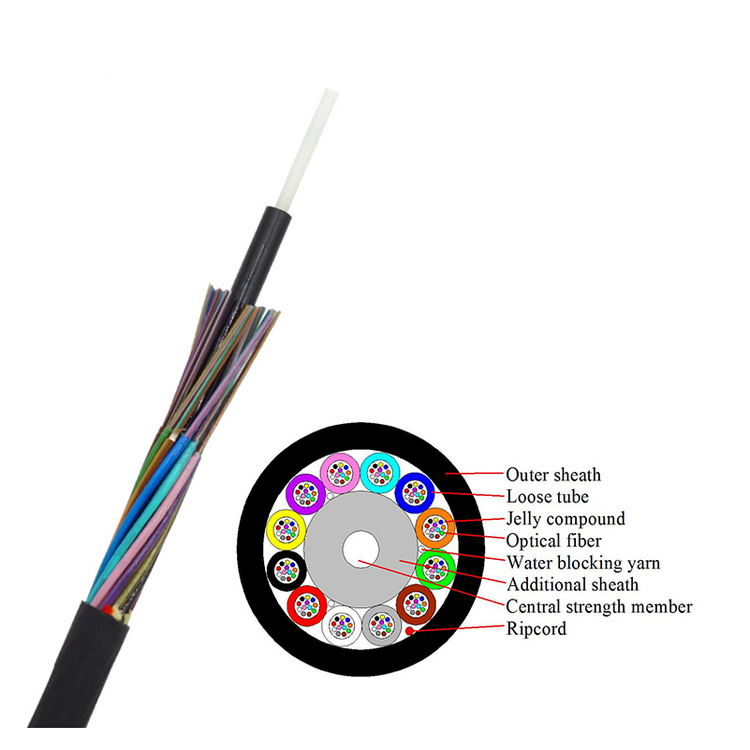
Ideal for last-mile connections in dense urban environments where conduit space is limited. The small form factor allows operators to maximize fiber counts in existing underground ducts without expensive civil works.
Used extensively in data centers and corporate campuses for backbone cabling. The lightweight nature simplifies installation in raised floors and ceiling trays, reducing structural load and installation time.
HFC network upgrades often utilize air blown micro cables to add fiber nodes efficiently. This supports hybrid architectures that deliver high-speed internet alongside traditional video services.
Municipal projects increasingly deploy micro cables for IoT sensor networks and public safety communications. Their durability and ease of installation make them suitable for street-level distribution points.
The typical minimum bend radius for installed air blown micro cable is 10x the cable diameter, and 20x during installation. This flexibility allows for tight routing around corners and through complex conduit paths without damaging the optical fibers inside.
Yes, one of the primary advantages of air blown micro cable is its ability to be installed in existing, congested conduits using compressed air blowers. As long as the conduit has adequate free space (typically at least 30-40% filling ratio), you can inject new micro cables without disrupting existing infrastructure.
When installed correctly according to manufacturer specifications, air blown micro cables have a design life of 25+ years. The robust jacket materials and protective buffer coatings ensure long-term performance even in harsh environmental conditions.
We recommend requesting sample lengths to verify compatibility with your specific blowing equipment and conduit conditions. Testing helps ensure smooth large-scale deployment and minimizes risk during the initial phases of your project.
Privacy statement: Your privacy is very important to Us. Our company promises not to disclose your personal information to any external company with out your explicit permission.
Fill in more information so that we can get in touch with you faster
Privacy statement: Your privacy is very important to Us. Our company promises not to disclose your personal information to any external company with out your explicit permission.