


Please Leave Us A Message
Privacy statement: Your privacy is very important to Us. Our company promises not to disclose your personal information to any external company with out your explicit permission.


A direct buried fiber optic cable is a specialized communication medium designed to be installed directly underground without the need for additional conduit protection. These cables are engineered with robust mechanical and moisture-resistant features to withstand harsh soil conditions, ensuring reliable data transmission for outdoor telecommunications networks.
Shenzhen Guangtong Optical Co., Ltd has been providing high-quality direct buried fiber optic solutions since 2010. Our products are manufactured under strict ISO 9000 quality management systems, ensuring that every cable meets international standards for durability and performance in demanding environments.
Whether you are planning a large-scale FTTH deployment or a regional backbone network, our direct burial cables offer a cost-effective and durable solution for long-distance connectivity.
Our cables feature steel wire armor or fiberglass reinforcement to withstand crushing forces and rodent attacks during direct burial installation. This ensures long-term structural integrity even in difficult terrain.
Fully gel-filled core and water-swelling tapes prevent moisture ingress, protecting optical fibers from corrosion and signal loss caused by groundwater or rain saturation over time.
Every batch of direct buried fiber optic cable undergoes rigorous testing according to ISO 9000 standards. We guarantee consistent attenuation values and tensile strength for every kilometer produced.
With exports to America, Europe, the Middle East, Southeast Asia, and Pacific states, we understand international compliance requirements and deliver on-time for global projects.
At Shenzhen Guangtong Optical Co., Ltd, quality is not just a checkpoint; it is embedded in our manufacturing process. Our advanced production lines for SZ stranded cables, central tube cables, and all-dielectric self-supporting (ADSS) cables ensure precision in every layer of the direct buried fiber optic cable.
We use materials compliant with European Union directives and various international laws and regulations. This commitment to material safety and environmental responsibility helps your project meet sustainability goals while maintaining peak performance.
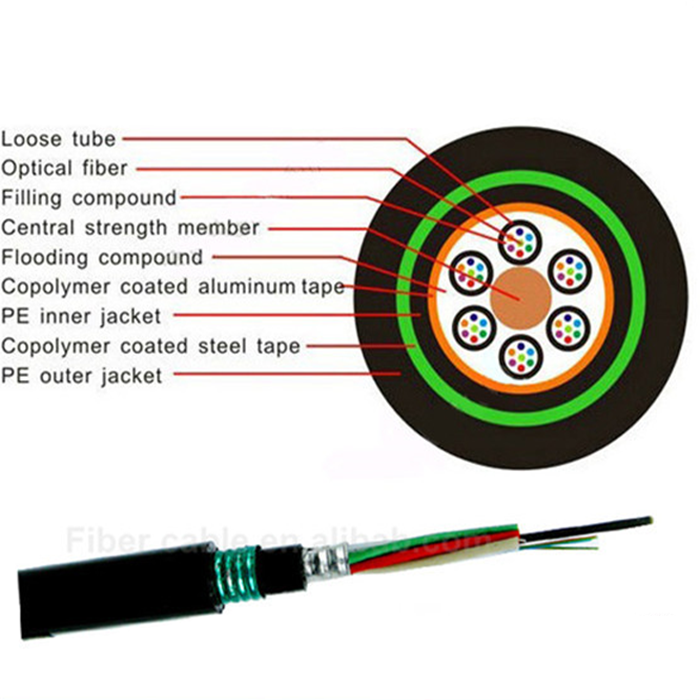
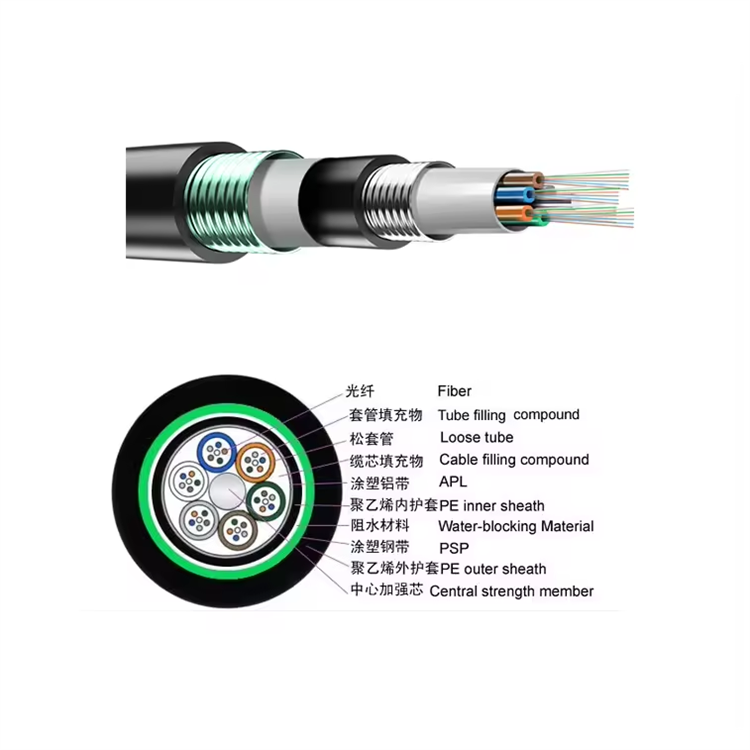
Selecting the correct direct buried fiber optic cable requires careful consideration of your installation environment and network requirements. Here are the key factors to evaluate:
For areas with high rodent activity or potential digging risks, choose a cable with steel wire armor. For electrically sensitive sites where grounding is difficult, opt for fiberglass reinforcement (non-metallic) to avoid lightning strikes and interference.
Determine the required fiber count (e.g., 12, 24, 48, 96 cores) based on current needs and future expansion plans. Single-mode fibers (G.652.D) are standard for long-distance direct burial applications due to their low attenuation and high bandwidth.
High-density polyethylene (HDPE) black sheaths provide excellent resistance to UV, chemicals, and abrasion. Ensure the sheath thickness is sufficient for the expected soil load.
Look for radial water-blocking methods such as water-swellable tapes or gels. This prevents water migration along the cable length if the outer sheath is compromised.
Solution: Specify cables with full radial water-blocking technology. Guangtong Optical uses gel-filled cores and swelling tapes to ensure zero moisture ingress, preventing long-term signal degradation.
Solution: Use armored cables with corrugated steel tape or double steel wires. Our armored direct burial cables are tested for rodent resistance, significantly reducing maintenance costs.
Solution: Partner with ISO 9000 certified manufacturers like Guangtong Optical. Our strict QC process ensures that every reel matches the specified attenuation and tensile strength standards.
Solution: Choose HDPE sheaths with appropriate carbon black content for UV stability and chemical resistance. Verify the sheath thickness rating against your soil conditions.
Solution: Work with suppliers who have global export experience. We handle logistics efficiently to America, Europe, and Asia, ensuring your project stays on schedule.
Solution: Guangtong Optical provides dedicated support for cable selection, installation guidelines, and troubleshooting, acting as your loyal partner throughout the project lifecycle.
Direct burial cables are ideal for connecting distribution frames to homes in rural or suburban areas where conduit infrastructure is unavailable.
Long-distance inter-city links require high-strength, armored cables to protect against geological shifts and external pressures.
Urban infrastructure projects use direct burial cables for street lighting control, traffic monitoring, and public Wi-Fi backhaul.
Campus-wide connections between buildings often utilize direct burial solutions for cost-effective and rapid deployment.
Factories and plants use ruggedized cables to connect remote sensors and control systems in harsh underground environments.
Specialized armored cables provide reliable communication in mining sites where equipment vibration and ground pressure are high.
Best For: End-to-end fiber solutions including ADSS, FTTH, and direct buried cables.
Founded in 2010, GT-Optical combines R&D with manufacturing, offering competitive pricing and strict quality control. Their export experience ensures smooth international transactions.
Manufacturing Capability: Look for suppliers with advanced SZ stranding and extrusion lines.
Quality Assurance: Prioritize companies with ISO 9000 certification and EU-compliant materials.
Support: Choose partners who provide technical guidance and act as loyal friends to your business.
Armored cables include steel wire or tape armor to provide protection against crushing forces and rodent attacks. Non-armored cables typically use fiberglass rods for tensile strength and are suitable for environments where metal interference is a concern. Choose armored for general direct burial and non-armored for specific electrical isolation needs.
Yes, but proper installation techniques are crucial. Armored cables with high crushing resistance ratings are recommended for rocky terrain to prevent damage from sharp stones. It is also advisable to use sand bedding under the cable to minimize point loads.
Yes, we encourage customers to request sample reels to test attenuation, tensile strength, and water-blocking performance before placing bulk orders. This ensures the product meets your specific project requirements.
Our manufacturing process adheres to ISO 9000 quality management standards. Additionally, our materials comply with European Union directives and various international regulations, ensuring global compatibility and safety.
Consider the number of endpoints, future expansion plans, and redundancy needs. A common practice is to install 20-30% more fibers than currently required to accommodate future growth without costly re-excavation.
Privacy statement: Your privacy is very important to Us. Our company promises not to disclose your personal information to any external company with out your explicit permission.
Fill in more information so that we can get in touch with you faster
Privacy statement: Your privacy is very important to Us. Our company promises not to disclose your personal information to any external company with out your explicit permission.