


Please Leave Us A Message
Privacy statement: Your privacy is very important to Us. Our company promises not to disclose your personal information to any external company with out your explicit permission.


Fiber drop cables are the critical final link in Fiber to the Home (FTTH) infrastructure, connecting the local network distribution point directly to the end-user's premises. Designed for high flexibility and durability, these cables ensure reliable signal transmission in challenging installation environments.
Shenzhen Guangtong Optical Co., Ltd specializes in manufacturing advanced fiber drop solutions that meet rigorous international standards. Our products are engineered to withstand environmental stressors while maintaining low attenuation, ensuring your customers receive consistent high-speed connectivity.
Why it matters: Choosing the right drop cable reduces installation time and long-term maintenance costs, protecting your investment in last-mile infrastructure.
At GT-Optical, our Shenzhen-based facility combines advanced production technology with strict quality management. We utilize state-of-the-art SZ stranding and central tube cabling equipment to produce fiber drop cables that exceed industry performance benchmarks.
Our commitment to quality is backed by an ISO 9000 certified management system. Every batch of fiber optic drop cable undergoes rigorous testing to ensure compliance with European Union directives and global regulatory standards.
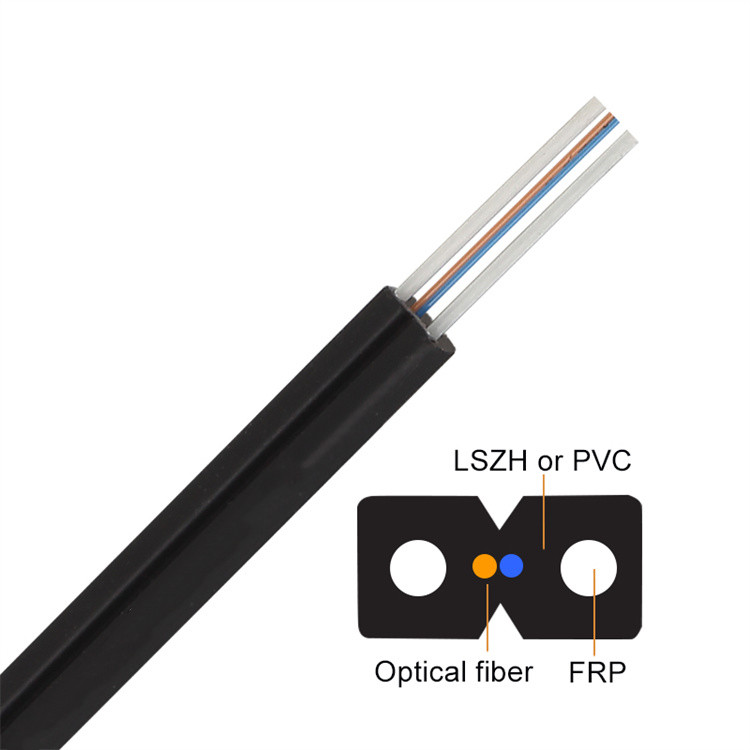
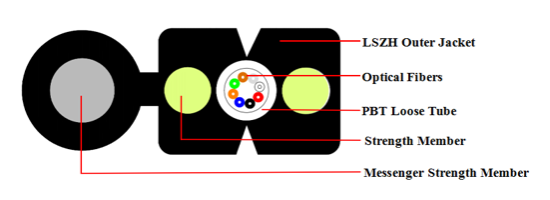
Selecting the optimal fiber drop cable requires balancing technical specifications with installation constraints. Buyers must consider factors such as bending radius, tensile strength, and environmental protection ratings.
Bending Performance: Look for cables with enhanced bend-insensitive fibers (G.657.A1/A2) to navigate tight corners in residential installations without signal loss.
Durability: For aerial drops, choose All-Dielectric Self-Supporting (ADSS) variants that can span distances without metallic support. For conduit installs, smooth-sheathed cables reduce friction.
Connector Pre-termination: Pre-terminated drop cables significantly speed up deployment and reduce on-site splicing errors, lowering your total cost of ownership.
Before finalizing your procurement order, verify these critical criteria to ensure product reliability and supplier accountability.
Many buyers face issues where cable performance varies between production batches. This leads to field failures and costly rework.
Suppliers using substandard jacket materials may fail EU environmental directives, risking customs seizures and legal liabilities.
Without proper engineering guidance, incorrect cable selection can compromise the entire FTTH network's longevity and signal integrity.
When evaluating potential partners for your fiber drop cable needs, prioritize suppliers who demonstrate a holistic approach to quality and service.
Look for companies founded on "integrity management" that invest heavily in both R&D and production equipment. A supplier with in-house testing capabilities ensures you receive exactly what is specified.
Choose suppliers with a proven export history to diverse markets like America, Europe, and Southeast Asia. This experience indicates an ability to handle complex logistics and varying regulatory requirements.
ADSS (All-Dielectric Self-Supporting) cables are designed for aerial installation without needing a separate support messenger wire. Standard drop cables typically require conduit or existing support structures. ADSS offers greater flexibility for rural or overhead deployments.
ISO 9000 certification ensures that the manufacturer follows a standardized quality management system. This results in consistent product performance, reduced defect rates, and reliable supply chains for bulk orders.
Yes. GT-Optical strictly controls materials to comply with European Union directives and various international laws and regulations. This ensures safe import and usage in regulated markets.
We specialize in SZ stranded cables, central tube cables, all dielectric self-supporting (ADSS) cables, and various drop cable configurations tailored for FTTH applications.
Shenzhen is a hub for high-tech optical manufacturing. Suppliers like GT-Optical have established track records exporting to America, Europe, the Middle East, and Southeast Asia, demonstrating robust logistical and quality capabilities.
Privacy statement: Your privacy is very important to Us. Our company promises not to disclose your personal information to any external company with out your explicit permission.
Fill in more information so that we can get in touch with you faster
Privacy statement: Your privacy is very important to Us. Our company promises not to disclose your personal information to any external company with out your explicit permission.