


Please Leave Us A Message
Privacy statement: Your privacy is very important to Us. Our company promises not to disclose your personal information to any external company with out your explicit permission.


FTTH drop cable is the critical final link in fiber-to-the-home networks, connecting the service provider's distribution point directly to your customer's residence. This specialized cable ensures reliable high-speed internet delivery for residential applications.
Unlike backbone cables designed for long-distance transmission, FTTH drop cable is engineered for flexibility and easy installation in complex indoor and outdoor environments. It supports various deployment methods including aerial, conduit, and direct burial installations.
The design typically includes lightweight materials with optimized strength members that withstand tension during pulling while maintaining signal integrity over distances up to 100 meters. Modern drop cables feature all-dielectric construction for safe outdoor use near power lines.
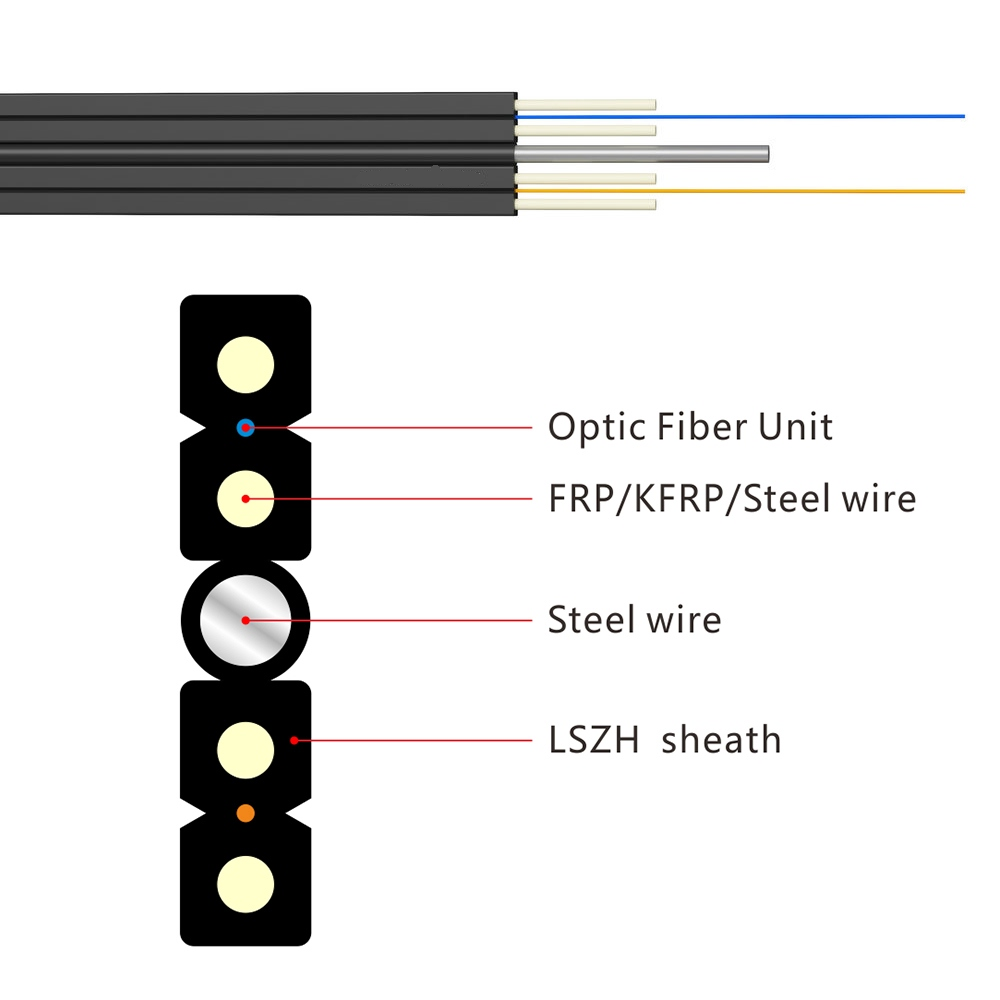
Shenzhen Guangtong Optical Co., Ltd has been a trusted manufacturer of fiber optic solutions since 2010. Our FTTH drop cable products are designed to meet the rigorous demands of modern broadband deployments worldwide.
Our facility features SZ stranding equipment, central tube cables, and ADSS production lines ensuring consistent quality across all drop cable variants.
All materials comply with EU directives and international standards. Our ISO 9000 certified processes guarantee batch-to-batch consistency.
Exported to America, Europe, Middle East, Southeast Asia, and Pacific states with zero major quality incidents over 14 years of operation.
Our engineering team provides complete technical documentation and installation guidance for every FTTH drop cable order.
At Guangtong Optical, quality control begins at the raw material stage and continues through every manufacturing step. Our FTTH drop cable production follows strict ISO 9000 protocols to ensure each unit meets performance specifications.
Every batch of PE jacketing, aramid yarn, and fiber tubes undergoes incoming inspection for tensile strength, UV resistance, and environmental compliance.
Real-time monitoring of extrusion temperatures, drawing speeds, and tension controls ensures dimensional accuracy within ±0.5mm tolerance.
Each production run includes attenuation testing, temperature cycling (-40°C to +70°C), and water immersion tests to verify long-term reliability.
Complete test reports, material safety data sheets, and compliance certificates provided with every shipment for customs and regulatory clearance.
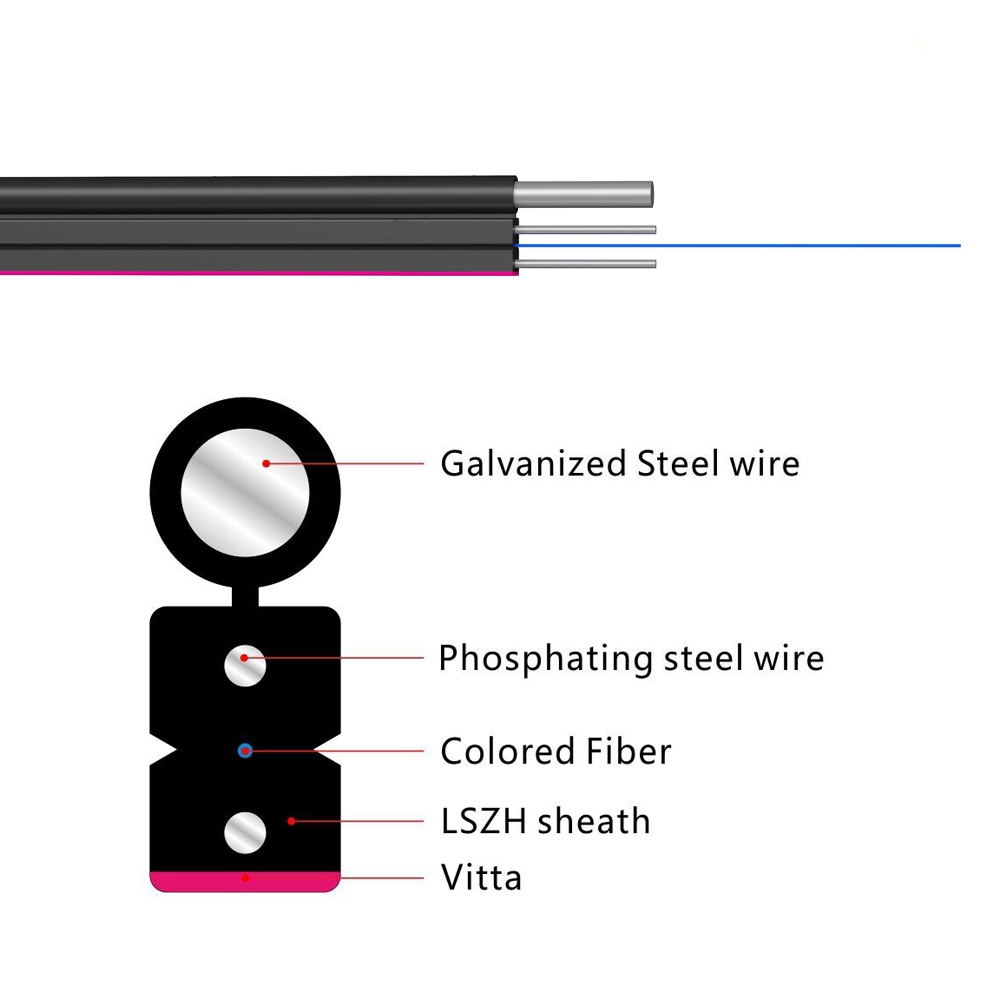
Selecting the appropriate FTTH drop cable requires understanding your specific installation environment and performance requirements. The wrong choice can lead to premature failure, increased maintenance costs, and service disruptions.
Aerial: Requires self-supporting design with messenger wire or DSS construction for span lengths up to 50m.
Conduit: Needs smooth outer jacket for easy pulling through existing infrastructure.
Direct Burial: Demands moisture-blocking gel and armored protection against rodent damage.
Most residential applications require 2-fiber cables (one transmit, one receive). However, future-proof installations may benefit from 4-fiber options providing redundancy and upgrade capacity for PON network expansions.
Outdoor drops need UV-resistant PE jacketing and operating temperatures from -40°C to +70°C. Indoor sections require LSZH (Low Smoke Zero Halogen) compounds for fire safety compliance in building interiors.
Consider bend radius requirements (typically 10x cable diameter), minimum pull tension limits, and termination method compatibility with your existing splice closure and distribution frame equipment. Pre-terminated drop cables reduce field labor costs by up to 40% compared to field-terminated alternatives.
Before finalizing your procurement decision, verify these critical factors to ensure your FTTH drop cable investment delivers long-term value and reliability.
When evaluating potential suppliers for your FTTH drop cable requirements, consider these industry best practices for selecting a reliable manufacturing partner.
Prioritize suppliers with integrated production facilities offering complete control over the manufacturing process. In-house SZ stranding, extrusion, and testing capabilities ensure consistent quality and faster response to custom requirements.
Choose manufacturers with proven experience spanning multiple years and diverse geographic markets. A supplier exporting to America, Europe, and Asia demonstrates adaptability to different regulatory environments and customer expectations.
Verify that suppliers maintain documented quality management systems with regular third-party audits. ISO certification alone isn't sufficient—look for suppliers who actively monitor production parameters and provide detailed test reports.
Suppliers offering comprehensive fiber optic solutions (drop cables, distribution cables, splice closures) simplify procurement and reduce coordination complexity. Single-source relationships often yield better pricing and priority treatment.
Responsive communication throughout the quotation and order process indicates how well a supplier will handle post-sale issues. Evaluate response times, technical knowledge, and willingness to provide samples for testing.
Compare total value rather than unit price alone. Consider factors like minimum order quantities, sample costs, tooling fees, and volume discounts. Transparent pricing without hidden charges builds trust for long-term partnerships.
FTTH drop cable serves as the essential connection between optical distribution networks and end-user premises. Its versatility enables deployment across diverse environments and installation scenarios.
The primary application connects individual homes to fiber optic networks. Drop cables route from street cabinets or poles through conduits or aerial spans into residential buildings, terminating at optical network terminals (ONTs).
Apartment complexes and condominiums require specialized drop cable configurations with centralized distribution points. Fire-rated LSZH cables meet building code requirements for vertical riser and horizontal runs within structures.
Long-span aerial deployments in rural areas demand robust self-supporting drop cables capable of withstanding extreme weather conditions. These installations often require customized lengths and reinforced messenger wires.
Office buildings and retail spaces use drop cables for internal fiber distribution to individual workstations. Bend-insensitive fibers enable tight routing around obstacles while maintaining signal performance for gigabit services.
Understanding common challenges helps buyers avoid costly mistakes when sourcing FTTH drop cable. Here are frequently encountered issues and their solutions.
Problem: Higher-than-expected loss values reducing network performance.
Solution: Verify fiber grade (G.657.A1/A2 bend-insensitive recommended), check splice quality, and confirm proper handling during installation. Request factory test reports showing attenuation values below 0.35dB/km at 1310nm.
Problem: UV exposure causing cracking or discoloration in outdoor installations.
Solution: Specify black PE jacketing with carbon black pigment for UV resistance. Ensure cables meet IEC 60794-1-2-E2 weathering standards for 20-year outdoor lifespan.
Problem: Moisture penetration leading to fiber degradation and increased attenuation.
Solution: Use gel-filled cables for direct burial or select dry-water swellable tape designs. Verify IP68 rating and conduct water blocking tests per IEC 60794-1-2-B1.
Problem: Excessive pull tension or sharp bends damaging fiber strands.
Solution: Implement proper installation procedures with tension monitors. Maintain minimum bend radius of 10x cable diameter during and after installation. Train crews on correct pulling techniques.
Problem: Connector types or cable dimensions incompatible with existing infrastructure.
Solution: Confirm connector specifications (SC/APC, FC/APC, or LC) before ordering. Verify cable diameter matches splice closure and distribution frame entry ports.
Problem: Extended lead times disrupting project schedules.
Common questions about FTTH drop cable selection, installation, and procurement answered by our technical team.
High-quality FTTH drop cables are designed for a 20-25 year operational lifespan when installed according to manufacturer specifications. Proper installation practices, including maintaining bend radius requirements and avoiding excessive tension, ensure long-term reliability.
Yes, but you must select the appropriate cable type. Outdoor drops require UV-resistant PE jacketing and moisture protection, while indoor sections need LSZH (Low Smoke Zero Halogen) compounds for fire safety. Many installations use a combination approach with separate cable sections for each environment.
Pre-terminated cables come with factory-installed connectors offering lower insertion loss and higher consistency. Field-terminated cables allow customization but require skilled technicians and testing equipment. Pre-terminated options typically reduce installation time by 30-40%.
Most residential applications require 2 fibers (transmit and receive). However, 4-fiber cables provide redundancy and future-proofing for network upgrades. Consider your PON architecture, potential service expansions, and budget constraints when making this decision.
Essential certifications include ISO 9000 for quality management, CE marking for EU compliance, and RoHS for hazardous substance restrictions. Additional certifications like Telcordia GR-20, IEC 60794, and UL listings may be required depending on your target market.
Minimum order quantities vary by configuration and supplier. Standard configurations typically have lower MOQs due to existing inventory. Custom specifications may require larger commitments. Contact suppliers directly for current MOQ policies and sample ordering procedures.
Store cables in original packaging away from direct sunlight and moisture. Maintain storage temperatures between -20°C and +40°C. When handling, avoid dropping reels and use proper cable pulling equipment to prevent damage to the fiber strands or jacketing.
Privacy statement: Your privacy is very important to Us. Our company promises not to disclose your personal information to any external company with out your explicit permission.
Fill in more information so that we can get in touch with you faster
Privacy statement: Your privacy is very important to Us. Our company promises not to disclose your personal information to any external company with out your explicit permission.